|
 |
 |
 |
初代 小原雲心家元
First Headmaster Unshin Ohara |
二世 小原光雲家元
Second Headmaster Koun Ohara |
 |
 |
 |
三世 小原豊雲家元
Third Headmaster Houn Ohara |
四世 小原夏樹家元
Fourth Headmaster Natsuki Ohara |
五世 小原宏貴家元
Fifth Headmaster Hiroki Ohara |
Unshin Ohara (1861-1916), the founder of the Ohara School of Ikebana, was
born in Matsue City, Shimane Prefecture.
Unshin explored the fields and mountains and tried to develop a style of
ikebana to express the beauty of natural scenery. He also searched for
ways to arrange the brightly colorful Western flowers that had just begun
to be imported into Japan. The result of his efforts was Moribana, the
first brilliant step in modern ikebana. In 1897, the first public exhibition
of ikebana in the Moribana Style was held.
 |
| Arrangement of Moribana by Unshin Ohara |
The Ohara School was officially founded in 1912, and in 1916, Unshin was
succeeded by Second Headmaster Koun Ohara (1880-1938), who developed and
established set techniques for Moribana. Koun held ikebana exhibitions
in public places like department stores, and worked hard to promote Ohara
ikebana to the great mass of ordinary people of that time.In addition,
he paid considerable attention to developing practical teaching methods
and to the systematic classification of expressive techniques. He established
clear rules and distinctions for floral styles in Moribana and Heika. He
also made a special effort to address large groups of people, using blackboards
and microphones and also originated methods of mass instruction like demonstrations
before an audience, where he arranged flowers from behind the work so that
the audience had a clear view. Almost all contemporary ikebana school have
adopted the methods first used by Koun. In his own work, he broke new ground
in Nature Moribana, now called landscape Moribana, with his expression
of vast scenic views of Hokkaido and his depiction of the appearance of
the water’s edge in arrangements of mizumono, which are aquatic plants
or plants closely associated with views of water.
 |
| Arrangement of Moribana by Koun Ohara |
Third Headmaster Houn Ohara (1908-1995) succeeded his father in 1938. As
soon as the Second World War was over, he began his creative activity.
In November 1945, he displayed works in Kobe in the show window of the
Daimaru Department Store, which had survived the devastation of war. Houn's
work brought some measure of relief to the disheartened population. His
Sangeiten exhibition in 1946 marked the beginnings of avant-garde ikebana
and created an enormous sensation. In his one-person exhibition in 1949,
Creations by Houn Ohara, the word “Objet”, a French term from surrealist
art, was first used in ikebana. Through numerous personexhibitions,he continued
at the forefront of modern ikebana with constantly renewed creativity.
In 1964, Houn Ohara created Rimpa Arrangement, which was based on the highly
decorative works of the Rimpa paintings, which flourished during the Edo
Period. Representative artists include Ogata Korin and Tawaraya Sotatsu.
Within the school itself, he made efforts to expand and systematize the
organization. He also deserves great credit for transforming the school
into a world-wide organization.
 |
| Arrangement of Rimpa by Houn Ohara |
 |
| "Objet"by Houn Ohara |
Houn's son Natsuki (1949-1992) became Headmaster Designate in 1972. Father
and son held many joint exhibitions, and Natsuki embodied the future hopes
and expectations of the Ohara School. He explored the possibilities of
ikebana in search of richly creative forms appropriate for the new age,
and originated Hanamai and Hana-isho. he was naturally expected to succeed
his father, but he became ill and passed away while Houn was still Headmaster.
Natsuki was posthumously named Fourth Master.
 |
| Arrangement of Hanamai by Natsuki Ohara |
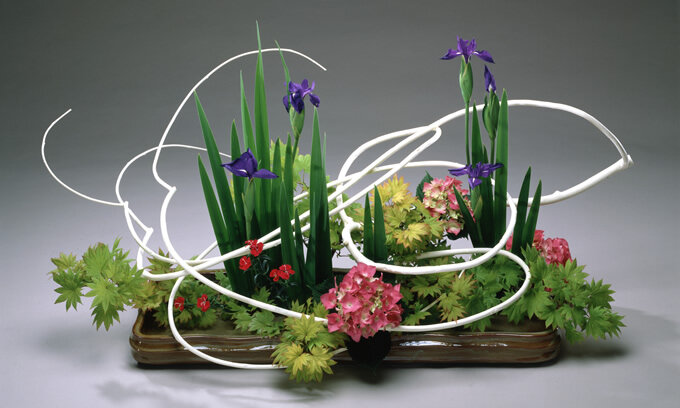
In the 21 st century, the Ohara School is expected to prosper further led
by young Fifth Headmaster Hiroki Ohara.With main offices in Tokyo, Osaka
and Kobe, 158 Chapters in Japan and 57 Chapters and 27 Study Groups out
of Japan. (As of November, 2009), the Ohara School has over one million
students throughout the world.
 |
| Large-scaled arrangement by Hiroki Ohara |
|